There are books you cannot put down, page-turners that keep you from finishing your work on time.
And then there are books you
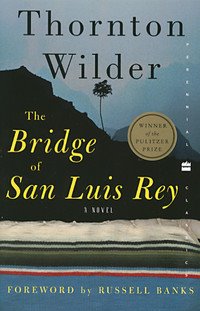
have to put down, like Thornton Wilder’s
The Bridge of San Luis Rey—for you to catch your breath, for you to pump the air with your fist (quietly, of course, lest The Coach wakes from his slumber), for you to reflect on things beyond your ordinary grasp.
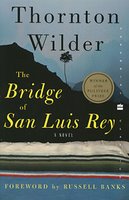
The proposition is provocative: a rope footbridge in Peru, known throughout, breaks in the year 1714, and five people plunge into the chasm below. Brother Juniper who was only a few steps away from crossing the bridge copes with his near-death by grappling with questions—his own brand of catechism: Why these five people? Why spare him? Is it destiny that dictates their deaths? He needs to make sense of the disaster, to find order behind the chaos. He investigates each of the five, chronicling the big and the small of their lives. He mulls: “Either we live by accident and die by accident, or we live by plan and die by plan.” Ironically, the bridge ultimately claims him as its sixth victim: he, with his work, is in the end burned alive for heresy.
Thornton raises questions on “acts of God,” a term I first encountered in law school, sounding to me then severely ominous, like the imprecatory slaying of thousands or the F5 twister. The term, as it is used in contracts, is synonymous to fortuitous events. I remember wondering how lawyers could consider God’s acts—He whom we Christians deem sovereign—as merely happenstance.
Brother Juniper’s commitment to his quest is fueled by his previous, systematic cataloging of fifteen Peruvians who survived and fifteen who died in an earlier pestilence in another town. Brother Juniper rated these thirty people from 1 to 10 on different criteria: each life or soul’s goodness, piety and usefulness. Such calculations were meant to support or counter theological assumptions: do the good really die young? Are the wicked spared from death?
Which, for me, begs another question: is God fair? Did God ordain life to be fair? Our neighbor, truly searching for guidance, accosted me with that question right after the tsunami hit Aceh. We ended up—six of us neighbors—bringing potluck and bibles to our house and discussing the issue further.
God and fair play: what a tricky issue to handle. Something, perhaps, for another day in this blog. Something I’d really like to think about in more depth, too.
I caught the latest film version of
The Bridge of San Luis Rey on cable about two months ago but had to let go after some time. I couldn’t continue watching the film. I love Kathy Bates dearly and she is often magnificent in her roles, but in my mind she is not the Marquesa, no. Even Robert de Niro failed to move me. I couldn’t look past their accents and see the book’s Lima, Peru. I’m not sure if that was the film’s fault or mine. Perhaps it would be really difficult to adapt a story wrestling with deep philosophical issues.