It hurts to laugh.
While most of my stitches are healing well, the hole on my right, through which a pipe drained blood and liquid for four days, still gapes and throbs. When I sneeze I anchor my tummy in with my hands, afraid that the force might hurl my insides through the gauze. Rising in the morning is a major production: I slowly maneuver to my left, slip an elbow underneath, secure my right palm on the bed, and lift myself up by degrees. It does not help that The Coach keeps our bedroom Siberia-cold (I have to burrow under three covers!); my joints are all stiff, and much of my body refuses to wake.
But.
I cannot help but check out Himantayon for my regular fix of laugh-out-loud Cebuano humor. The term himantayon means—geez, now how on earth do I translate that? (Me, with my clumsy Tagalog.) A pakialamero is more of a meddler and a busybody. A himantayon—from the word bantay—is more circumspect and subtle in his or her snooping, though no less heedful or alert or even catty, though never malevolent. A glamorous gossip, how 'bout that?
(Help, I am floundering. It's like explaining the mechanics of labyog and kumbayot.)
Anyway, this site, which I discovered through fellow Cebuano Isolde Amante's*, celebrates all things BisDak—that's Bisayang Dako or "Big Bisaya," literally, though that translation fails at capturing the self-jest that can be at times droll or comical or tongue-in-cheek or farcical or downright clownish.
I love it. It's home. And I'll read it if it kills me.
* If you crave good fiction, check out Isolde's Dance, deservedly a winner at the 2000 Palancas.
The Coach's Wife
Tuesday, May 22, 2007

Monday, May 21, 2007
A Round Tuit
One can never have too much rest. Or so I thought. After having been sidelined for more than five months, I'm unusually looking forward to work, family duties, and house chores, even. Yessir, hell has officially frozen over.
June is the magic month to return to the trenches: set up a piggy bank, work out at least 40 hours in 90 days, finish a story. I borrowed tickers from TickerFactory.com to monitor my progress.
For the procrastinator in me I simplified my desktop and got a Round Tuit.

Remember all the things we were supposed to do when we got around to it? Well, there ya go: I finally got a round tuit. Here are more round tuits from other sites.

June is the magic month to return to the trenches: set up a piggy bank, work out at least 40 hours in 90 days, finish a story. I borrowed tickers from TickerFactory.com to monitor my progress.
For the procrastinator in me I simplified my desktop and got a Round Tuit.

Remember all the things we were supposed to do when we got around to it? Well, there ya go: I finally got a round tuit. Here are more round tuits from other sites.

Saturday, May 19, 2007

The art of solitude
The world operates on noise. Too many of us who find some alone time keep the TV or music playing to ward off the quiet. What one perceives as silence could be an acquired deafness.
It is increasingly difficult to imagine life without our handhelds and entertainment equipment. We wouldn’t know what to do with ourselves without computers, TV, books or cell phones. There is rarely space reserved for elegant thought. I see so many in a commute or in a line send text messages or strap on iPods rather than pause for contemplation.
I faced this point squarely when typhoon Reming in October 2000 forced me to confront a brownout alone in the city. A few months prior, I had scheduled some alone-time in Sagada and Banaue, free from pagers, phones and the Internet. The escape didn’t happen, regrettably, but the point is I thought I was prepared for isolation.
I wasn't. The brownout bore down with a darkness broken only by distant emergency lights. No activity or panorama to deflect my solitude. It was unnerving. I was overwhelmed by my bare thoughts, and frantic for cable television or a book.
I did not know when it was when I was first sucked into a treadmill of activity. I just knew I had to simplify my life.
To enjoy a quiet time with myself, no typing into a keyboard, no writing, no reading.
To find pieces of myself in memorabilia and old photos, and laugh at the cuts and scrapes of my childhood.
To think about where I came from, the distance I’ve covered, and the path I will take.
To be mindful of my breathing, just feel the air in and out.
I remind myself of this now because after a forced five-month rest, I can feel the pull back into the busyness vortex, unable to write yesterday, for instance, without listening to music or to the television. A few weeks ago my friend Art asked me how long it has been since my last dive. Blank. I couldn’t remember. “Whoa,” he said. “Now I know you are busy.”
Germaine had been more direct last year. “You, my friend,” she announced, “are a workaholic.”
“No, I’m not,” I said. “I just have too much work.”
Perhaps I should start listening to myself.
It is increasingly difficult to imagine life without our handhelds and entertainment equipment. We wouldn’t know what to do with ourselves without computers, TV, books or cell phones. There is rarely space reserved for elegant thought. I see so many in a commute or in a line send text messages or strap on iPods rather than pause for contemplation.
I faced this point squarely when typhoon Reming in October 2000 forced me to confront a brownout alone in the city. A few months prior, I had scheduled some alone-time in Sagada and Banaue, free from pagers, phones and the Internet. The escape didn’t happen, regrettably, but the point is I thought I was prepared for isolation.
I wasn't. The brownout bore down with a darkness broken only by distant emergency lights. No activity or panorama to deflect my solitude. It was unnerving. I was overwhelmed by my bare thoughts, and frantic for cable television or a book.
I did not know when it was when I was first sucked into a treadmill of activity. I just knew I had to simplify my life.
To enjoy a quiet time with myself, no typing into a keyboard, no writing, no reading.
To find pieces of myself in memorabilia and old photos, and laugh at the cuts and scrapes of my childhood.
To think about where I came from, the distance I’ve covered, and the path I will take.
To be mindful of my breathing, just feel the air in and out.
I remind myself of this now because after a forced five-month rest, I can feel the pull back into the busyness vortex, unable to write yesterday, for instance, without listening to music or to the television. A few weeks ago my friend Art asked me how long it has been since my last dive. Blank. I couldn’t remember. “Whoa,” he said. “Now I know you are busy.”
Germaine had been more direct last year. “You, my friend,” she announced, “are a workaholic.”
“No, I’m not,” I said. “I just have too much work.”
Perhaps I should start listening to myself.
Wednesday, May 09, 2007
Perfect love
 Off to the hospital in a few hours for tests to prep me for Friday's surgery, this time to have four holes bored into me in a laparoscopic cholicystectomy—terribly expensive medico-babble to remove my ailing gall bladder.
Dreading yet another round of needles and stitches, fasting, and sleep deprivation (the nurses' specialty, oh how they excel at it). It's the second in this year's medical drama, and, please God, the last.
The Coach has of late been working 18-hour days, juggling his job and my hospital preps and funding, but—bless him—he still takes time to soothe my fears. When we got wind this morning of the staggering costs that would again dent our budget, he was, in his words, "not worried, but..." And he paused, the mobile phone connection clear enough to relay his sigh, "...I am shaken." Then he gathered himself, becoming the tender warrior that he is, and said, "This is not a problem, Jan. As long as we're together, we're okay."
He sleeps now, bone-tired, and perhaps will only be a bit refreshed when he rises in just a few hours to put in some work before he brings me to the hospital.
Poor dear. How can I tell him I am not prepared for tomorrow when he himself has gone through as much emotional turmoil as I have? He will quote to me one of his favorite psalms, "Call upon Me in the day of trouble; I will deliver you, and you shall glorify Me." He will remind me of the Lord's faithfulness in all the good and bad years we've been together—twenty-one!—and tick off the many things we are grateful for, and then he will hug me, make me laugh and think of all the junk food and trans fats I can finally have in my post-op diet.
Tonight I choose to meditate on Paul's words to young Timothy, "For God has not given us a spirit of fear, but of power and of love and of a sound mind." The argument is easy to follow: The Lord loves me more than I can ever comprehend, He who knitted me carefully in my mother's womb; His Will for me is perfect, acceptable and pleasing; He is mighty to save; how He desires me to fare on Friday is all part of His purpose for me. There is no room for fear for perfect love—His, and what He shows through The Coach—casts out fear.
Thank you, Coach, for being the Lord's strongest tangible reminder of His love.
Tuesday, May 08, 2007
Moon and Stars
 Here in Manila I have an inordinate interest in the moon. I take hundreds of photos. A few days ago I took one of the moon lingering in the sky after daybreak. Tonight's Jeopardy! tells me this is called selenodolatry: moon worship.
But that's just because only a few stars can penetrate the smog. I love stars more. Sometimes the best part of our dive trips is the time we spend on the sand gazing up the night sky: with stars upon stars it feels like all 6,000 visible stars are on our side of the world. In Apo Island, the marine reserve off Dumaguete, the stars leap out of the sky when the island plunges into darkness after the power generators switch off around 10. Even the fireflies cannot compete. One night we counted 24 falling stars.
Naming the Stars
Joyce Sutphen
This present tragedy will eventually
turn into myth, and in the mist
of that later telling the bell tolling
now will be a symbol, or, at least,
a sign of something long since lost.
This will be another one of those
loose changes, the rearrangement of
hearts, just parts of old lives
patched together, gathered into
a dim constellation, small consolation.
Look, we will say, you can almost see
the outline there: her fingertips
touching his, the faint fusion
of two bodies breaking into light.

Monday, May 07, 2007
Play by Play

The Coach is child-mischievous. In church today, while everybody else applauded an all-male ensemble who had sang a cappella In That Great Getting Up Morning—in a delightful fusion of barbershop music and black gospel—The Coach leaned over and whispered, “I’m going to clap like Paula Abdul.” And he bent his hands back, fingers splayed, and slapped his palms together—Paula Abdul style.
That kind of playfulness serves him well on radio. For some time now The Coach moonlights as commentator at Radyo PBA (918 on the AM frequency).
Radio suits him more. When he was commentating on TV for the Metropolitan Basketball Association (MBA), he had to mind too many things: wear a tie, follow the camera, and mind his facial expressions. Radio, however, allows him to banter about, say, the players’ hair, or poke fun even at himself. “Whew!” he whistled, when Olsen Racela sank in a shot after The Coach had pronounced Olsen one of the league’s best free-throw players. “Buti na lang. Otherwise, mawawalan ako ng credibility.”
In another game, after The Coach had kept insisting the Welcoat players should pass the ball to Alex Compton, Alex delivered the fifth of his seven 3-point shots that game, and The Coach cheered, “Naku, gumwapo ako dun ah.”
Of the few games I've listened in on, my favorite would be the Air 21-Welcoat game last April. Air 21 was miles ahead in scoring, and Welcoat struggled to make a shot, as if—according to The Coach—there was a wall blocking their shots. “Eh, ano pang dapat gawin ng Welcoat kung may wall, eh 'di pinturahan,” he joshed.
Saturday, May 05, 2007
Networking

Absolutely brilliant.
Enter a word in Visuwords, an online graphical dictionary, and words that relate to your entry just pop, spring, ricochet and expand into a color-coordinated web of synonyms, opposites, hypernyms, and derivations.

When the words settle down into a fully-fleshed network, they gently throb and breathe, like the living things that they are. Such a delight.
And the dictionary is free.
(Discovered from "Write now is good.")
Friday, May 04, 2007
Writering
In his Penman column for April 2, 2007, Butch Dalisay wrote that he and his colleagues—Charlson Ong, Jimmy Abad, Jing Hidalgo, and Ricky de Ungria—were, in the early years of their writing, “driven and fascinated by writing, not by being or becoming writers.”
I remember my “anxieties and apprehensions” (my professor’s words) when I started out, more of which centered on being a writer than by writing, though there was that, too. Perhaps it was because I came from a profession that overly—and mistakenly—valued titles. Except for SyCip Salazar law office, the first law firm I joined, there was never any Miss or Mister among us: it was the ATTY. that defined us. My classmates said that one earns one letter for every year in law school, from the A to the Y, and then get the period when he or she passes the Bar.
A few years ago I wrote this in my journal. I feel a certain sadness when I read this, even as I have gone past this spell:
I need to own to being a writer—a term I wear like clothes that are too snug on me. What do you do, people ask, and I say, Well, and I pause, Well, I am a writer. I shrug and tug my shoulders to bridge the moment.
It does not help that my mother and father—both of whom slaved to see me get my letters A to Y—think that writing is not a real job. You write when you’re happy or sad. You do not write to live.
I carry the term with some deprecation, like I should issue an apology—Yes, ma’am, I am trying to write and maybe someday I will create something good. And perhaps continue to create something good.
I know I can write—people tell me so, and there are instances in my scribbling when I know I have written something well, and I rejoice in the wordplay—but I am not certain I deserve to be called a writer. I write, perhaps, but I am not a writer.
 Alice Munro’s character in The Office has her own version of writerly disquiet:
The solution to my life occurred to me one evening while I was ironing a shirt. It was simple but audacious. I went into the living room where my husband was watching television and I said, “I think I ought to have an office.”
It sounded fantastic, even to me. What do I want an office for? I have a house; it is pleasant and roomy and has a view of the sea; it provides appropriate places for eating and sleeping, and having baths and conversations with one's friends. Also I have a garden; there is no lack of space.
No. But here comes the disclosure which is not easy for me: I am a writer. That does not sound right. Too presumptuous; phony, or at least unconvincing. Try again. I write. Is that better? I try to write. That makes it worse. Hypocritical humility. Well then?
It doesn’t matter. However I put it, the words create their space of silence, the delicate moment of exposure. But people are kind, the silence is quickly absorbed by the solicitude of friendly voices, crying variously, how wonderful, and good for you, and well, that is intriguing. And what do you write, they inquire with spirit. Fiction, I reply, bearing my humiliation by this time with ease, even a suggestion of flippancy, which was not always mine, and again, again, the perceptible circles of dismay are smoothed out by such ready and tactful voices—which have however exhausted their stock of consolatory phrases, and can say only, “Ah!”
So this is what I want an office for (I said to my husband): to write in. I was at once aware that it sounded like a finicky requirement, a piece of rare self-indulgence. To write, as everyone knows, you need a typewriter, or at least a pencil, some paper, a table and chair; I have all these things in a corner of my bedroom. But now I want an office as well.
And I was not even sure that I was going to write in it, if we come down to that. Maybe I would sit and stare at the wall; even that prospect was not unpleasant to me. It was really the sound of the word “office” that I liked, its sound of dignity and peace. And purposefulness and importance. But I did not care to mention to this to my husband, so I launched instead into a high-flown explanation which went, as I remember, like this:
A house is all right for a man to work in. He brings his work into the house, a place is cleared for it; the house rearranges itself as best it can around him. Everybody recognizes that his work exists. He is not expected to answer the telephone, to find things that are lost, to see why the children are crying, or feed the cat. He can shut his door. Imagine (I said) a mother shutting her door, and the children knowing she is behind it; why, the very thought of it is outrageous to them. A woman who sits staring into space, into a country that is not her husband’s or her children’s is likewise known to be an offence against nature. So a house is not the same for a woman. She is not someone who walks into the house, to make use of it, and will walk out again. She is the house; there is no separation possible.
(And this is true, though as usual when arguing for something I am afraid I do not deserve, I put it in too emphatic and emotional terms. At certain times, perhaps on long spring evenings, still rainy and sad, with the cold bulbs in bloom and a light too mild for promise drifting over the sea, I have opened the windows and felt the house shrink back into wood and plaster and those humble elements of which is it made, and the life in it subside, leaving me exposed, empty-handed, but feeling a fierce and lawless quiver of freedom, of loneliness too harsh and perfect for me now to bear. Then I know how the rest of the time I am sheltered and encumbered, how insistently I am warmed and bound.)
I remember my “anxieties and apprehensions” (my professor’s words) when I started out, more of which centered on being a writer than by writing, though there was that, too. Perhaps it was because I came from a profession that overly—and mistakenly—valued titles. Except for SyCip Salazar law office, the first law firm I joined, there was never any Miss or Mister among us: it was the ATTY. that defined us. My classmates said that one earns one letter for every year in law school, from the A to the Y, and then get the period when he or she passes the Bar.
A few years ago I wrote this in my journal. I feel a certain sadness when I read this, even as I have gone past this spell:
I need to own to being a writer—a term I wear like clothes that are too snug on me. What do you do, people ask, and I say, Well, and I pause, Well, I am a writer. I shrug and tug my shoulders to bridge the moment.
It does not help that my mother and father—both of whom slaved to see me get my letters A to Y—think that writing is not a real job. You write when you’re happy or sad. You do not write to live.
I carry the term with some deprecation, like I should issue an apology—Yes, ma’am, I am trying to write and maybe someday I will create something good. And perhaps continue to create something good.
I know I can write—people tell me so, and there are instances in my scribbling when I know I have written something well, and I rejoice in the wordplay—but I am not certain I deserve to be called a writer. I write, perhaps, but I am not a writer.
 Alice Munro’s character in The Office has her own version of writerly disquiet:
The solution to my life occurred to me one evening while I was ironing a shirt. It was simple but audacious. I went into the living room where my husband was watching television and I said, “I think I ought to have an office.”
It sounded fantastic, even to me. What do I want an office for? I have a house; it is pleasant and roomy and has a view of the sea; it provides appropriate places for eating and sleeping, and having baths and conversations with one's friends. Also I have a garden; there is no lack of space.
No. But here comes the disclosure which is not easy for me: I am a writer. That does not sound right. Too presumptuous; phony, or at least unconvincing. Try again. I write. Is that better? I try to write. That makes it worse. Hypocritical humility. Well then?
It doesn’t matter. However I put it, the words create their space of silence, the delicate moment of exposure. But people are kind, the silence is quickly absorbed by the solicitude of friendly voices, crying variously, how wonderful, and good for you, and well, that is intriguing. And what do you write, they inquire with spirit. Fiction, I reply, bearing my humiliation by this time with ease, even a suggestion of flippancy, which was not always mine, and again, again, the perceptible circles of dismay are smoothed out by such ready and tactful voices—which have however exhausted their stock of consolatory phrases, and can say only, “Ah!”
So this is what I want an office for (I said to my husband): to write in. I was at once aware that it sounded like a finicky requirement, a piece of rare self-indulgence. To write, as everyone knows, you need a typewriter, or at least a pencil, some paper, a table and chair; I have all these things in a corner of my bedroom. But now I want an office as well.
And I was not even sure that I was going to write in it, if we come down to that. Maybe I would sit and stare at the wall; even that prospect was not unpleasant to me. It was really the sound of the word “office” that I liked, its sound of dignity and peace. And purposefulness and importance. But I did not care to mention to this to my husband, so I launched instead into a high-flown explanation which went, as I remember, like this:
A house is all right for a man to work in. He brings his work into the house, a place is cleared for it; the house rearranges itself as best it can around him. Everybody recognizes that his work exists. He is not expected to answer the telephone, to find things that are lost, to see why the children are crying, or feed the cat. He can shut his door. Imagine (I said) a mother shutting her door, and the children knowing she is behind it; why, the very thought of it is outrageous to them. A woman who sits staring into space, into a country that is not her husband’s or her children’s is likewise known to be an offence against nature. So a house is not the same for a woman. She is not someone who walks into the house, to make use of it, and will walk out again. She is the house; there is no separation possible.
(And this is true, though as usual when arguing for something I am afraid I do not deserve, I put it in too emphatic and emotional terms. At certain times, perhaps on long spring evenings, still rainy and sad, with the cold bulbs in bloom and a light too mild for promise drifting over the sea, I have opened the windows and felt the house shrink back into wood and plaster and those humble elements of which is it made, and the life in it subside, leaving me exposed, empty-handed, but feeling a fierce and lawless quiver of freedom, of loneliness too harsh and perfect for me now to bear. Then I know how the rest of the time I am sheltered and encumbered, how insistently I am warmed and bound.)
Thursday, May 03, 2007
Oh, joy, joy!
My Closopen story does not really deal with food so it came somewhat as a surprise when editors Cecilia Mangerra Brainard and Marily Ysip Orosa included it in the A La Carte food anthology. I was ecstatic.
 We read portions of our stories at the February 12 launching at the Podium. I was sandwiched* between two writers I highly respect, Butch Dalisay and Dean Alfar, whose Amnesty and Terminos are required reading in my literature pilot class.
This being a food and fiction book, Dean read of adobo, while Butch read about egg rolls.
I read about poop.
Because I have foot-in-mouth disease when I feel terribly inadequate—say, like reading about poop next to a table laden with food—I turned to Butch and said, "My poop can beat your egg rolls." To accommodate me, he laughed. He had also laughed when, in my first day of class under his tutelage, I mumbled something about his probably being ornery (I was nervous, see? And late for class). He was telling us to write to our highest standard, to write for those who are ornery, fussy and difficult to please. I blurted, "But that's almost the entire English department." And the dear man from the English Department (he was the dean, alas!) laughed as I swallowed my tongue, buried my head in the sand, and shot myself. Closopen was the first I wrote for his class, and the first that I submitted for an anthology.
Tonight I chanced upon the Passion for books article of the Sunday Inquirer Magazine, listing A la Carte as a must-read for summer and Closopen as a choice cut. Oh, the joy of being affirmed for what one does!
 We read portions of our stories at the February 12 launching at the Podium. I was sandwiched* between two writers I highly respect, Butch Dalisay and Dean Alfar, whose Amnesty and Terminos are required reading in my literature pilot class.
This being a food and fiction book, Dean read of adobo, while Butch read about egg rolls.
I read about poop.
Because I have foot-in-mouth disease when I feel terribly inadequate—say, like reading about poop next to a table laden with food—I turned to Butch and said, "My poop can beat your egg rolls." To accommodate me, he laughed. He had also laughed when, in my first day of class under his tutelage, I mumbled something about his probably being ornery (I was nervous, see? And late for class). He was telling us to write to our highest standard, to write for those who are ornery, fussy and difficult to please. I blurted, "But that's almost the entire English department." And the dear man from the English Department (he was the dean, alas!) laughed as I swallowed my tongue, buried my head in the sand, and shot myself. Closopen was the first I wrote for his class, and the first that I submitted for an anthology.
Tonight I chanced upon the Passion for books article of the Sunday Inquirer Magazine, listing A la Carte as a must-read for summer and Closopen as a choice cut. Oh, the joy of being affirmed for what one does!
"A La Carte (Food & Fiction)"
Collected and edited by Cecilia Manguerra Brainard and Marily Ysip Orosa
Anvil PublishingYou'll need two vital ingredients before you start devouring this book: a full stomach and a comfortable seat some distance away from a working kitchen and a food court. Because definitely, a hungry reader will be torn between finishing the sumptuous stories and rushing off to try out the recipes offered as appetizer at the start of each chapter. The tasty morsels leave you convinced that food is more than just repast; it is also the stuff of national pride, childhood memory, romance, regret, rivalry, and even bloody murder. This book is one thick bubbling stew that satisfies one's hunger and imagination while whetting the appetite for more. Best cuts: "Wok Man" by Jose Dalisay, Jr.; "Closopen" by Janet Villa, "No Salt" by Nadine Sarreal, "Pedro and the Chickens" by Ian Rosales Casocot, "Kitchen Secrets" by Shirlie Mae Choe, and "Does It Matter What the Dead Think?" by Erwin Cabucos. (by Penny Azarcon-de la Cruz)
* Sandwiched, har har. Pun really not intended but, hey, still appreciated.

Wednesday, May 02, 2007
'Twas a dark and stormy night...
Nyaaarrr.
The day after I submitted my Quentin the Question Mark (who, by the way, is renamed Quiting—not really an interesting story there, but could probably tell you next time), I take those la-la-la quizzes about ourselves—this is what we do when we, as the Polymath says, have no life—and I am told that Quentin, and apparently I, will sink into a mire.
And what are the odds: immediately after I watch tonight's episode of Jeopardy!, from which I learned that chicken fat is called shmaltz, I am told that all I really want to do is roll around in chicken fat.
The Polymath, of course, has recently assured me that the chicken is the sickest animal on the planet.
Yeehaa.


What horrible Edward Gorey Death will you die?
>

You will sink in a mire. You like to think you're normal, but deep down you really just want to strip off your clothes and roll around in chicken fat.
Take this quiz!

Quizilla |
Join
| Make A Quiz | More Quizzes | Grab Code
The day after I submitted my Quentin the Question Mark (who, by the way, is renamed Quiting—not really an interesting story there, but could probably tell you next time), I take those la-la-la quizzes about ourselves—this is what we do when we, as the Polymath says, have no life—and I am told that Quentin, and apparently I, will sink into a mire.
And what are the odds: immediately after I watch tonight's episode of Jeopardy!, from which I learned that chicken fat is called shmaltz, I am told that all I really want to do is roll around in chicken fat.
The Polymath, of course, has recently assured me that the chicken is the sickest animal on the planet.
Yeehaa.
What horrible Edward Gorey Death will you die?
You will sink in a mire. You like to think you're normal, but deep down you really just want to strip off your clothes and roll around in chicken fat.
Take this quiz!
Quizilla |
Join
| Make A Quiz | More Quizzes | Grab Code
Monday, April 30, 2007
Dead Lines
 3:10 AM
My friend, Alvin, calls me a little before midnight, pep-talking me into submitting a story, an essay, anything, to the Palancas. Today, of course, is the deadline.
There will be little sleep today for those who, like me, ride on the adrenaline rush to write after, say, needing to watch CSI, Criminal Minds and Medium. The story I wish I’d submit requires more than a few hours’ work, so this time I’ll dip into my hay naku, puede na folder and tweak a story. To add more complication, let's make it, hey, a children's story, knowing that I have no sensibility for such. As a final nouement, let's choose Quentin, whose story does not conform to the Palancas' requirement that the entry be "directed principally to promote appreciation of Filipino literature or culture."
I figure this foolhardiness fulfills two objectives: one, it lets me keep a new year’s resolution, and two, it serves me right for not coming up with something new.
From where I write I can see the moon, bigger than yesterday’s. Its beauty is of no help, for I keep staring at it, and my thoughts fly elsewhere, far.
I prefer to blog.
Serves me right.
 5:10 AM
Day comes earlier in summer, and so does the deadline. I'm having the impossible time excoriating multi-syllable words from the story and catching into my language the rhythm of children laughing.
Serves me right.
Sunday, April 29, 2007
Gumption
It is 2 in the morning as I write this. Before me, this scene.
 A gibbous moon, hanging low, gorged and almost full. Lights from a construction site from across the street that curves to my right. A few cars on the road. A gas station half-asleep. Most of the city in dreams. Silence.
I take a long time to write. It is hard to sort out the many thoughts roiling in my head. Even harder to find the words.
I can always make a convenient excuse: I’ve recently undergone anesthesia, as well as had a drug injected into my forearm to make me forget the indignities the medical staff did to prep me for surgery—a date-rape drug, the anesthesiologist told me. His name is Christian Doctor. Really. He is Doctor Doctor, my doctor. I met him right when they wheeled me into the O.R. Laid out flat on the gurney I felt an urge to create a limerick. When you’re about to face uncertainty and still feel like reaching for a pen and paper, that makes you, in my book, a writer.
In my first year in creative writing school, Butch Dalisay had told us, his timorous class, “Have the gumption to call yourself a writer.” Of course I didn’t believe him. Two years later, I did. I was watching an Ateneo-La Salle game from the referee’s table next to the Ateneo bench when a scuffle among the on-court players erupted into a free-for-all. Alums from both schools charged into the court. From the audience behind us, Rico Villanueva and someone else—maybe Rainier Sison?—vaulted over the railing, swinging. It was blue and green mayhem. I scrambled under the table, took out my Palm and tap-tapped about the chaos around me. That’s when I knew, for sure, that I was a writer, when the only way for me to make sense of things was to reduce them to words, when the words were almost, almost as meaningful as the event unfolding.
I regret abandoning this blog for such a long time. My life has, since October, been suspended by a court case, an operation last February, and yet another surgery this May. It is hard to make plans. But I can write about it, perhaps to help me find a way, some way, to navigate through my why’s.
 A gibbous moon, hanging low, gorged and almost full. Lights from a construction site from across the street that curves to my right. A few cars on the road. A gas station half-asleep. Most of the city in dreams. Silence.
I take a long time to write. It is hard to sort out the many thoughts roiling in my head. Even harder to find the words.
I can always make a convenient excuse: I’ve recently undergone anesthesia, as well as had a drug injected into my forearm to make me forget the indignities the medical staff did to prep me for surgery—a date-rape drug, the anesthesiologist told me. His name is Christian Doctor. Really. He is Doctor Doctor, my doctor. I met him right when they wheeled me into the O.R. Laid out flat on the gurney I felt an urge to create a limerick. When you’re about to face uncertainty and still feel like reaching for a pen and paper, that makes you, in my book, a writer.
In my first year in creative writing school, Butch Dalisay had told us, his timorous class, “Have the gumption to call yourself a writer.” Of course I didn’t believe him. Two years later, I did. I was watching an Ateneo-La Salle game from the referee’s table next to the Ateneo bench when a scuffle among the on-court players erupted into a free-for-all. Alums from both schools charged into the court. From the audience behind us, Rico Villanueva and someone else—maybe Rainier Sison?—vaulted over the railing, swinging. It was blue and green mayhem. I scrambled under the table, took out my Palm and tap-tapped about the chaos around me. That’s when I knew, for sure, that I was a writer, when the only way for me to make sense of things was to reduce them to words, when the words were almost, almost as meaningful as the event unfolding.
I regret abandoning this blog for such a long time. My life has, since October, been suspended by a court case, an operation last February, and yet another surgery this May. It is hard to make plans. But I can write about it, perhaps to help me find a way, some way, to navigate through my why’s.
Friday, October 27, 2006
The web that is wide as the world
Seems almost strange to be blogging in the midst of a personal storm, like there's something absolutely capricious about this, when there are—what?—things more important or urgent, and there is no time, even.
But the act of writing this gives me a sense of normalcy, and I feel the need to connect to you, like Whitman's spider on the promontory, just throwing filament after filament after filament, and this comforts me somewhat, this attempt to connect to the "vacant vast surrounding," we who find ourselves in "measureless oceans of space."
And now I extend my leave—a blog break, they call it—perhaps for another week or so, so I can, as the psalmist says, be still and know that He is God, my Abba Father.
To be, to simply be, is awfully difficult for human beings who would rather be human doings.
But the act of writing this gives me a sense of normalcy, and I feel the need to connect to you, like Whitman's spider on the promontory, just throwing filament after filament after filament, and this comforts me somewhat, this attempt to connect to the "vacant vast surrounding," we who find ourselves in "measureless oceans of space."
And now I extend my leave—a blog break, they call it—perhaps for another week or so, so I can, as the psalmist says, be still and know that He is God, my Abba Father.
To be, to simply be, is awfully difficult for human beings who would rather be human doings.
Tuesday, September 19, 2006
Justice denied
 Time Magazine (August 28, 2006 issue) reported there are more Americans who can name off the bat two of Snow White's seven dwarfs than two Supreme Court justices.
I can believe that.
I probably know more of the cast of Ed or Gilmore Girls than of those who sit at the Kataas-taasang Hukuman ng Pilipinas. A scenario most likely not limited to me.
Which is a shame, for that reveals our lack of political will, a loss by default not to lead ourselves.
Starting tomorrow I will have to fly to Cebu several times to help protect my family against the consequences of such an apathy, this time from among city government employees. I will, literally, have to fight City Hall.
As a lawyer I know the courts will not listen to me unless I establish a clear legal right to get a temporary restraining order (TRO) against a private project protected by those in power. As a citizen I burn in anger because I should not be required to prove why my rights should not be overtaken so.
I ran into walls at City Hall just trying to explain that, yes, I am a part of those whom the government serves, and stand equal with my rich next-door neighbor, never mind her powerful political connections.
A gargantuan task, especially when my parents—a schoolteacher and a local government employee, both retired—can rely only on the family's collective wits and determination.
Among the fallout in this case that leave a bad taste in the mouth are three I detest the most: filing a case; parrying with the head honcho who, I have been thrice warned, is vindictive; and dealing with the media.
Oh, to be left in peace to just write.
The evils of the world are better seen in fictive light.
Tuesday, September 12, 2006
Face Value
Warning: Terribly longish post about how a distorted view of beauty creates pain, but well worth, I think, the time to read, as well as the time I spent in ruminating, reading, and interviewing celebrities (the medical and non-medical kind). This work-in-progress is incomplete; I'm still struggling over certain areas. My perspective, of course, is Christian. I welcome yours.
Would Prince Charming have kissed Sleeping Beauty if she weren’t, well, a beauty? Would he have singled out Cinderella from across the ballroom if her waist-to-hip ratio weren’t 0.73?
Perhaps not. No matter how much we want it otherwise, beauty is not merely skin deep, particularly for those of us who frantically hop on the beauty treadmill, reconstructing what Mother Nature gave us, fighting to halt the ravages of time—sculpting, buffing, peeling, tattooing, lifting, augmenting, suctioning, plucking. The beauty industry that ranges from fashion to cosmetics, from diet plans to fitness studios, from salons to plastic surgery, grows and thrives on the mindset that physical beauty is the primary standard by which we consciously or unconsciously “categorize” a woman.
Television—the de facto, modern-day arbiter of taste and value—feeds on this need for female beauty. Advertisers capitalize on appearance: even commercials that do not sell or are not in any way related to beauty products portray the wiles and wares of a stunning woman. Cigarettes, beer, cellular phones, bathroom tiles, refrigerators—apparently these gain life and increase in sales only in the hands of a dazzling temptress. According to a U.S. study, more than 5,000 commercials with “attractiveness messages” hypnotize viewers each year. Much of the merchandise marketed exclusively on TV panders to the woman’s desire to look better by peddling near-miraculous beauty and makeover products: topical concoctions that shrink fat, enlarge the bust, and remove scars; Cleopatra foam-tipped springs that, when inserted into the nostril, literally lift the bridge for a perkier nose; and the Chinese growth balls that add inches to height when drank once in the morning and again before bedtime. What’s probably more remarkable is that sales are skyrocketing off the charts.
The public is partly to blame for this frenzy. While height is necessary for our flight attendants to reach overhead bins, we also unashamedly require them to be young and beautiful as they pour our coffee. We tend to listen more to good-looking salesladies, prompting companies to hire them primarily for their looks. Filipino TV viewers perpetuate the vicious cycle: we subconsciously but insidiously demand our performers and broadcasters to look physically appealing even before we determine their level of talent. Even worse, we excuse their lack of talent as long as they are attractive.
The beauty bias is rubbing off on non-celebrities. Plastic surgeons in the Philippines confirm that the openness of a few celebrities about their surgeries has drawn more “ordinary” folk to ask for procedures. They come to the clinic, bearing pictures of celebrities, wanting the nose of Nicole Kidman, desiring Barbie Doll proportions or those of Ethel Booba. (According to plastic surgeon Manny Calayan, the most commonly requested body in the country for the past two years is reportedly Ethel Booba’s—from her augmented breasts to her augmented behind, from the cheekbones etched on her face to the tweaked nose.)
There is no universally accepted ideal of female beauty, lending credence to the adage that beauty is in the eyes of the beholder. David Hume wrote in 1741 that “Beauty is not a quality in things themselves; it merely exists in the mind that contemplates them, and each mind perceives a different beauty.” Some cultures uninfluenced by media find the Rubenesque and Venus de Milo figures delightful, honoring the extra pounds as a sign of prosperity. Generally, however, most women are seduced by catwalk figures: at the height of Cindy Crawford and Claudia Schiffer’s popularity in the 1980s, the prevailing notion was of the robust, healthy woman. Then when the wispy Kate Moss and her scrawny posse crossed the threshold in the 1990s, they ushered in the trend of waif-like proportions (or the lack thereof). So far, this remains the vogue: women in fashion advertisements nowadays tend to be very thin, all the better to fit in the popular low-waist, hip-riding jeans. The average fashion model today reportedly weighs 23 percent less than the average female.
Sometimes women’s search for beauty is about desiring for what they are not or what they don’t have. This rather widespread attitude is further cultivated by media and manufacturers; the demand that is created—whether necessary or not—spurs sales. Caucasians, for instance, are persuaded to think brown skin exotic, and they spend much time under the sun and in tanning salons, or purchase tanning lotions to hide their pale skin. On the other hand, Filipinos and other Asians doggedly bow to the hegemony of Western media and yearn for fairer features, turning to papayas, citrus and chemicals to lighten their visage.
Perhaps the more scientific way of determining beauty is measuring the symmetry of a woman’s features or figure, the way that art is similarly studied for symmetry: there is harmony or beauty of form that results from balanced proportions. If, say, a woman’s face were to be folded in the middle and one side laid to rest on the other side, would the points of one part correspond with the other? If yes (as in the case of Jaclyn Smith or Paulina Poriskova), then there is symmetry, hence, beauty. If none, there is an imbalance that is considered unpleasant. This theory at its surface appears reasonable, but it hardly explains why many find Barbra Streisand beautiful despite her hooked nose, why Shannon Doherty used to land plum roles despite her noticeably uneven eyes, or why the distinctive gap between Lauren Hutton’s front teeth does not inordinately bother us so.
There is absolutely nothing wrong with wanting to be beautiful. To gaze at physical beauty gives us pleasure, in the same way that we find pleasure in the beauty of geometric shapes or colors or musical notes. However, to mindlessly clamber onto the beauty bandwagon, subjecting our bodies to immoderate demands, reveals a deeper need that begs to be assuaged.
For many women, physical beauty is more than eye candy: it is a key—to success, perhaps, however one defines success; or to fulfill a biological need; or maybe to obtain affirmation.
Time magazine in 2002 revealed a University of Texas discovery that “ugly people” (the description “ugly” referring to what is considered conventionally unpleasing to the eye) are paid ten percent less than employees with average looks. A similar study pointed out that, all things being equal, employers would hire taller people over those who are shorter.
Laboring under this collective demand for beauty, many celebrity wannabes get a head start on their cosmetic surgeries before they are launched into the world of entertainment. Dr. Vicky Belo reveals that actors are gradually accepting the fact that cosmetic surgery is an “investment in their career,” that their “face is part of [their] job.” Without knowing it, the good doctor echoes what Aristotle said about beauty being “a greater recommendation than any letter of introduction.”
The impact on the professional lives of the “redesigned” celebrities is immediate. Ella of Viva Hot Babes claims that after her bust augmentation, she received more offers to do shows. John Lapus says that after his chin sculpting and liposuction, he’s been receiving compliments from his friends, strangers and even enemies, and his career took off.
The case of World No. 3-ranked tennis star Maria Sharapova further proves that beauty can be a powerful determinant of success in business. Time magazine reported in 2005 that sponsors pay a premium for beauty in tennis and other women’s sports. Hence, Sharapova, with her blonde bombshell looks and trim 6-foot-2-inch frame, rakes in millions of dollars more in endorsements than her equally gifted female colleagues, notwithstanding that any one of these tennis phenoms can easily outplay her for any title.
Still others contend that the longing for beauty is much more primal than a business interest. Evolutionary scientists, including Charles Darwin, say that the dominant notion of beauty can be traced to our biologic need to procreate and is therefore “fundamental to the evolutionary process” of humans (as well as animals, apparently). According to biologists, there is a positive correlation between beauty, on the one hand, and fertility and good health on the other. Beauty acts as a “certification of biological quality,” which purportedly explains why, according to studies, men of diverse backgrounds prefer a low waist-to-hip ratio of 0.6 to 0.8 (meaning, the waist is 60% to 80% the size of the hips), regardless of the woman’s weight. Scientific experiments have apparently shown that a lower waist-to-hip ratio means a higher level of estrogen. More estrogen in the female body results in more reproductive fat on the hips and thighs. Ergo, men will be more attracted to women with an hourglass figure.
While this is an interesting aspect to the hubbub over beauty lust, it does not explain why women obsess about beauty. Childbearing is the farthest thing from the minds of those women who have their double chins removed, or those who permanently curl their eyelashes. The question is, why do we put so much weight on physical presentation?
It seems that we women latch on to beauty to affirm our sense of self; unfortunately, we equate our sense of self with the externals, which is why we rush to comb our fingers through our hair and lick our lips when someone insists on taking our picture (and why we keep only those pictures that show us in our best form), why we’d rather not tell our age, why we submit to the haunting truth in Janis Ian’s song: “I learned the truth at seventeen, that love was meant for beauty queens and high school girls with clear-skinned smiles.”
Many a woman cope with a bad experience by shopping, buying a new pair of shoes, or getting a haircut or a facial—addressing the pain inside mostly with feel-good instant makeovers. After a bad break-up or when a relationship falls apart, some women would get a bust augmentation. For many women, the aesthetic has become an anesthetic. Filipino poet Reuel Aguila recognizes this in his poem, Pagnanasa (Desire) 2: “From the botox of my face/ To the lipo of my tyan/ Nali-lift ang spirit/ Sa breast kong pina-enhance.” Women feel that physical beauty validates them. Even when women desire to be inconspicuous, there is still the dream of security and acceptance.
Theologians believe that the yearning for beauty finds its root in the curse that God put on the fallen Eve in Genesis 3:16: “Your desire will be for your husband, and he will rule over you.” Christian scholars argue that this desire will be inordinate, leading woman to find validation in man, seeking from him what he is not capable of. Andy Comiskey of the Living Waters Ministry argues that the curse upon Eve resulted in woman’s fallen tendency to find her identity in man, to seek completion in him, and mistakenly attempts to discover herself through him. Hence, many women mistakenly adopt men’s notions of female beauty as their guide. Her definition of beauty correlates to his: big breasts, small waist, thin thighs, oval face. Some studies confirm these assumptions. Anders Pape Moller, in his study Sexual Selection and the Biology of Beauty, presents human evolutionary psychological studies across cultures that reveal “how men rank female [physical] beauty the highest among a long list of attributes, while women rank male resources as the most important attribute of potential mates.” According to Bryn Mawr’s Savithri Ekanayake (The “Perfect” Female: an Analysis of the Biology of Beauty), studies from around the world found that “while both sexes value appearance, men place more stock in it than women.”
Regrettably, physical beauty is not the real beauty that is the essence of woman—what author Stasi Eldredge calls the “soulish” beauty— the kind that indwells in every woman and does not depend on her outward accoutrements. This kind of beauty takes its moorings from 1 Peter 3:3-4: “Your beauty should not come from outward adornment, such as braided hair and the wearing of gold jewelry and fine clothes. Instead, it should be that of your inner self, the unfading beauty of a gentle and quiet spirit.” Such beauty doesn’t translate to or require an introvert but a heart that is quieted by love and filled with peace, a heart that knows it already possesses beauty.
Eldredge submits that we women seek to unveil beauty within ourselves: deep inside, perhaps even deeper for those who have buried this essence in their hearts, women want to be seen, wanted, pursued and found beautiful and captivating, a beauty that is “core to who we truly are. We want beauty that can be seen; beauty that can be felt; beauty that affects others; a beauty all our own to unveil.”
Perhaps the antidote to the curse on the fallen Eve is to first recognize that woman’s beauty already resides in her from Day One. When God created man and woman, He said that what He had made was “very good.” (Genesis uses the superlative “very”—as in “very good”—only after He made man and woman; in all the other aspects of creation, He said they were “good.”) Creation celebrates woman as the bearer of God’s image, the Imago Dei. Eve was created because things were not right without her; she was not a mere afterthought. Something was not good, and “it [was] not good for the man to be alone.” God calls woman an ezer kenegdo, a Hebrew term that is difficult to translate: the term ezer is used only twenty other times in the Old Testament, and in these twenty times, ezer described God Himself, when He is needed desperately. And when God looked at her, He saw that she was “very good.”
Woman therefore is God’s piece de resistance. To paraphrase Eldredge: In the crescendo of creation, from formless void to perfection, woman is the beauty to which creation ascends. Only when woman accepts this—that she is the beauty that she already is—can she escape the beauty that ensnares.
Would Prince Charming have kissed Sleeping Beauty if she weren’t, well, a beauty? Would he have singled out Cinderella from across the ballroom if her waist-to-hip ratio weren’t 0.73?
Perhaps not. No matter how much we want it otherwise, beauty is not merely skin deep, particularly for those of us who frantically hop on the beauty treadmill, reconstructing what Mother Nature gave us, fighting to halt the ravages of time—sculpting, buffing, peeling, tattooing, lifting, augmenting, suctioning, plucking. The beauty industry that ranges from fashion to cosmetics, from diet plans to fitness studios, from salons to plastic surgery, grows and thrives on the mindset that physical beauty is the primary standard by which we consciously or unconsciously “categorize” a woman.
Television—the de facto, modern-day arbiter of taste and value—feeds on this need for female beauty. Advertisers capitalize on appearance: even commercials that do not sell or are not in any way related to beauty products portray the wiles and wares of a stunning woman. Cigarettes, beer, cellular phones, bathroom tiles, refrigerators—apparently these gain life and increase in sales only in the hands of a dazzling temptress. According to a U.S. study, more than 5,000 commercials with “attractiveness messages” hypnotize viewers each year. Much of the merchandise marketed exclusively on TV panders to the woman’s desire to look better by peddling near-miraculous beauty and makeover products: topical concoctions that shrink fat, enlarge the bust, and remove scars; Cleopatra foam-tipped springs that, when inserted into the nostril, literally lift the bridge for a perkier nose; and the Chinese growth balls that add inches to height when drank once in the morning and again before bedtime. What’s probably more remarkable is that sales are skyrocketing off the charts.
The public is partly to blame for this frenzy. While height is necessary for our flight attendants to reach overhead bins, we also unashamedly require them to be young and beautiful as they pour our coffee. We tend to listen more to good-looking salesladies, prompting companies to hire them primarily for their looks. Filipino TV viewers perpetuate the vicious cycle: we subconsciously but insidiously demand our performers and broadcasters to look physically appealing even before we determine their level of talent. Even worse, we excuse their lack of talent as long as they are attractive.
The beauty bias is rubbing off on non-celebrities. Plastic surgeons in the Philippines confirm that the openness of a few celebrities about their surgeries has drawn more “ordinary” folk to ask for procedures. They come to the clinic, bearing pictures of celebrities, wanting the nose of Nicole Kidman, desiring Barbie Doll proportions or those of Ethel Booba. (According to plastic surgeon Manny Calayan, the most commonly requested body in the country for the past two years is reportedly Ethel Booba’s—from her augmented breasts to her augmented behind, from the cheekbones etched on her face to the tweaked nose.)
There is no universally accepted ideal of female beauty, lending credence to the adage that beauty is in the eyes of the beholder. David Hume wrote in 1741 that “Beauty is not a quality in things themselves; it merely exists in the mind that contemplates them, and each mind perceives a different beauty.” Some cultures uninfluenced by media find the Rubenesque and Venus de Milo figures delightful, honoring the extra pounds as a sign of prosperity. Generally, however, most women are seduced by catwalk figures: at the height of Cindy Crawford and Claudia Schiffer’s popularity in the 1980s, the prevailing notion was of the robust, healthy woman. Then when the wispy Kate Moss and her scrawny posse crossed the threshold in the 1990s, they ushered in the trend of waif-like proportions (or the lack thereof). So far, this remains the vogue: women in fashion advertisements nowadays tend to be very thin, all the better to fit in the popular low-waist, hip-riding jeans. The average fashion model today reportedly weighs 23 percent less than the average female.
Sometimes women’s search for beauty is about desiring for what they are not or what they don’t have. This rather widespread attitude is further cultivated by media and manufacturers; the demand that is created—whether necessary or not—spurs sales. Caucasians, for instance, are persuaded to think brown skin exotic, and they spend much time under the sun and in tanning salons, or purchase tanning lotions to hide their pale skin. On the other hand, Filipinos and other Asians doggedly bow to the hegemony of Western media and yearn for fairer features, turning to papayas, citrus and chemicals to lighten their visage.
Perhaps the more scientific way of determining beauty is measuring the symmetry of a woman’s features or figure, the way that art is similarly studied for symmetry: there is harmony or beauty of form that results from balanced proportions. If, say, a woman’s face were to be folded in the middle and one side laid to rest on the other side, would the points of one part correspond with the other? If yes (as in the case of Jaclyn Smith or Paulina Poriskova), then there is symmetry, hence, beauty. If none, there is an imbalance that is considered unpleasant. This theory at its surface appears reasonable, but it hardly explains why many find Barbra Streisand beautiful despite her hooked nose, why Shannon Doherty used to land plum roles despite her noticeably uneven eyes, or why the distinctive gap between Lauren Hutton’s front teeth does not inordinately bother us so.
There is absolutely nothing wrong with wanting to be beautiful. To gaze at physical beauty gives us pleasure, in the same way that we find pleasure in the beauty of geometric shapes or colors or musical notes. However, to mindlessly clamber onto the beauty bandwagon, subjecting our bodies to immoderate demands, reveals a deeper need that begs to be assuaged.
For many women, physical beauty is more than eye candy: it is a key—to success, perhaps, however one defines success; or to fulfill a biological need; or maybe to obtain affirmation.
Time magazine in 2002 revealed a University of Texas discovery that “ugly people” (the description “ugly” referring to what is considered conventionally unpleasing to the eye) are paid ten percent less than employees with average looks. A similar study pointed out that, all things being equal, employers would hire taller people over those who are shorter.
Laboring under this collective demand for beauty, many celebrity wannabes get a head start on their cosmetic surgeries before they are launched into the world of entertainment. Dr. Vicky Belo reveals that actors are gradually accepting the fact that cosmetic surgery is an “investment in their career,” that their “face is part of [their] job.” Without knowing it, the good doctor echoes what Aristotle said about beauty being “a greater recommendation than any letter of introduction.”
The impact on the professional lives of the “redesigned” celebrities is immediate. Ella of Viva Hot Babes claims that after her bust augmentation, she received more offers to do shows. John Lapus says that after his chin sculpting and liposuction, he’s been receiving compliments from his friends, strangers and even enemies, and his career took off.
The case of World No. 3-ranked tennis star Maria Sharapova further proves that beauty can be a powerful determinant of success in business. Time magazine reported in 2005 that sponsors pay a premium for beauty in tennis and other women’s sports. Hence, Sharapova, with her blonde bombshell looks and trim 6-foot-2-inch frame, rakes in millions of dollars more in endorsements than her equally gifted female colleagues, notwithstanding that any one of these tennis phenoms can easily outplay her for any title.
Still others contend that the longing for beauty is much more primal than a business interest. Evolutionary scientists, including Charles Darwin, say that the dominant notion of beauty can be traced to our biologic need to procreate and is therefore “fundamental to the evolutionary process” of humans (as well as animals, apparently). According to biologists, there is a positive correlation between beauty, on the one hand, and fertility and good health on the other. Beauty acts as a “certification of biological quality,” which purportedly explains why, according to studies, men of diverse backgrounds prefer a low waist-to-hip ratio of 0.6 to 0.8 (meaning, the waist is 60% to 80% the size of the hips), regardless of the woman’s weight. Scientific experiments have apparently shown that a lower waist-to-hip ratio means a higher level of estrogen. More estrogen in the female body results in more reproductive fat on the hips and thighs. Ergo, men will be more attracted to women with an hourglass figure.
While this is an interesting aspect to the hubbub over beauty lust, it does not explain why women obsess about beauty. Childbearing is the farthest thing from the minds of those women who have their double chins removed, or those who permanently curl their eyelashes. The question is, why do we put so much weight on physical presentation?
It seems that we women latch on to beauty to affirm our sense of self; unfortunately, we equate our sense of self with the externals, which is why we rush to comb our fingers through our hair and lick our lips when someone insists on taking our picture (and why we keep only those pictures that show us in our best form), why we’d rather not tell our age, why we submit to the haunting truth in Janis Ian’s song: “I learned the truth at seventeen, that love was meant for beauty queens and high school girls with clear-skinned smiles.”
Many a woman cope with a bad experience by shopping, buying a new pair of shoes, or getting a haircut or a facial—addressing the pain inside mostly with feel-good instant makeovers. After a bad break-up or when a relationship falls apart, some women would get a bust augmentation. For many women, the aesthetic has become an anesthetic. Filipino poet Reuel Aguila recognizes this in his poem, Pagnanasa (Desire) 2: “From the botox of my face/ To the lipo of my tyan/ Nali-lift ang spirit/ Sa breast kong pina-enhance.” Women feel that physical beauty validates them. Even when women desire to be inconspicuous, there is still the dream of security and acceptance.
Theologians believe that the yearning for beauty finds its root in the curse that God put on the fallen Eve in Genesis 3:16: “Your desire will be for your husband, and he will rule over you.” Christian scholars argue that this desire will be inordinate, leading woman to find validation in man, seeking from him what he is not capable of. Andy Comiskey of the Living Waters Ministry argues that the curse upon Eve resulted in woman’s fallen tendency to find her identity in man, to seek completion in him, and mistakenly attempts to discover herself through him. Hence, many women mistakenly adopt men’s notions of female beauty as their guide. Her definition of beauty correlates to his: big breasts, small waist, thin thighs, oval face. Some studies confirm these assumptions. Anders Pape Moller, in his study Sexual Selection and the Biology of Beauty, presents human evolutionary psychological studies across cultures that reveal “how men rank female [physical] beauty the highest among a long list of attributes, while women rank male resources as the most important attribute of potential mates.” According to Bryn Mawr’s Savithri Ekanayake (The “Perfect” Female: an Analysis of the Biology of Beauty), studies from around the world found that “while both sexes value appearance, men place more stock in it than women.”
Regrettably, physical beauty is not the real beauty that is the essence of woman—what author Stasi Eldredge calls the “soulish” beauty— the kind that indwells in every woman and does not depend on her outward accoutrements. This kind of beauty takes its moorings from 1 Peter 3:3-4: “Your beauty should not come from outward adornment, such as braided hair and the wearing of gold jewelry and fine clothes. Instead, it should be that of your inner self, the unfading beauty of a gentle and quiet spirit.” Such beauty doesn’t translate to or require an introvert but a heart that is quieted by love and filled with peace, a heart that knows it already possesses beauty.
Eldredge submits that we women seek to unveil beauty within ourselves: deep inside, perhaps even deeper for those who have buried this essence in their hearts, women want to be seen, wanted, pursued and found beautiful and captivating, a beauty that is “core to who we truly are. We want beauty that can be seen; beauty that can be felt; beauty that affects others; a beauty all our own to unveil.”
Perhaps the antidote to the curse on the fallen Eve is to first recognize that woman’s beauty already resides in her from Day One. When God created man and woman, He said that what He had made was “very good.” (Genesis uses the superlative “very”—as in “very good”—only after He made man and woman; in all the other aspects of creation, He said they were “good.”) Creation celebrates woman as the bearer of God’s image, the Imago Dei. Eve was created because things were not right without her; she was not a mere afterthought. Something was not good, and “it [was] not good for the man to be alone.” God calls woman an ezer kenegdo, a Hebrew term that is difficult to translate: the term ezer is used only twenty other times in the Old Testament, and in these twenty times, ezer described God Himself, when He is needed desperately. And when God looked at her, He saw that she was “very good.”
Woman therefore is God’s piece de resistance. To paraphrase Eldredge: In the crescendo of creation, from formless void to perfection, woman is the beauty to which creation ascends. Only when woman accepts this—that she is the beauty that she already is—can she escape the beauty that ensnares.
Thursday, September 07, 2006
Give 'em hell, Coach!
At the dinner after UP’s exhilarating win against UE, everybody in the team was asked to say a few words—to say goodbye, reminisce about the season, share lessons learned, give thanks.
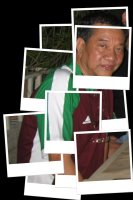
Head Coach Joe Lipa Jr., ever the mentor and tormentor, used more than a few words. To emphasize the import of his words, he would hark back to what he had already said, repeat it, this time accentuating his earnestness by chopping the air with his right hand and peppering his speech with OKs—as if to say, Are you listening to me, boys? OK?
On building character
(Number of times said: THREE)
 “Boys,” Coach Joe said, in his gravelly, pongalangala voice. “So many people have taught you basketball: from your grade-school coaches to your high-school coaches. What we from the UP coaching staff really want to do is to teach you to be better men. To be good persons. Nothing is more important than that. OK?”
This is the essence of Coach Joe’s father heart, the kind that singles out character, and knows when victory is important or not important.
On hell
(Number of times said: FIVE)
 The Coach, when it was his turn to speak, quoted from Coach Joe: “The road to success is always under construction.” I suspect this is where Coach Joe was coming from when he would, after already starting on another topic, suddenly remind the boys about training hell.
“Boys,” Coach Joe said, gripping the mike. “Starting next week, expect hell. OK?”
Variations of the same theme were minor:
On making good coaches
(Number of times said: TWO)
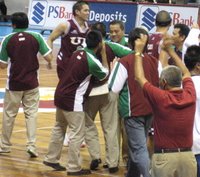 Turning to the other side of the lanai, Coach Joe faced his other “boys” and said, “To my coaching staff, you know that I want you to become good coaches. You also know that I am not fond of reading.* But because I want you to become good coaches and become good men, I have read many books on this, including the books of John Maxwell, so I can help you.”
Coach Joe’s strong personality and stronger convictions arouse either severe alienation or deep affection. He is like tennis star Rafa Nadal: he doesn’t leave his emotions in the locker room. He is like his friend,** Coach Bobby Knight (Indiana University): on and off the court, Coach Joe is intense and will make no bones showing what he feels.
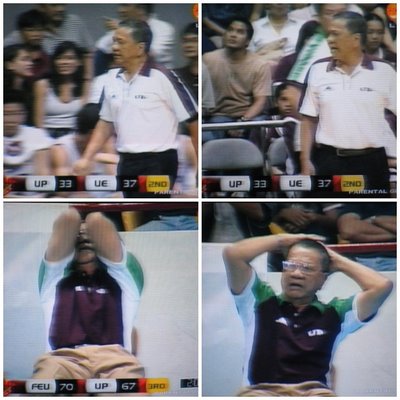
Either you love him or you hate him.
I love him. Very much. I have witnessed through the years how he has parented The Coach as a high-school player who would hang out at the gym to watch the UP MBT practices, as a college varsity player under Coach Joe's tutelage, as a young husband to a skittish wife, and then as a coach who would strike on his own.*** I have seen how, when Coach Joe makes a decision, he thinks of what legacy he can leave the boys: he thinks of consequences, not rewards. When facing any crossroads in his life, he doesn’t have to struggle over what is right and what is wrong: he always chooses what is right. What he does struggle over are the consequences that his right choices bring to his family. But because he is deeply loved, his family—especially dear Tita Ging with her sacrificial heart—walks with him through life’s many unfair twists and turns.
Just as we, whom he counts as friends, also gladly walk with him.
Coach Joe inspires loyalty. I have yet to meet another coach who, without trying, has maintained such love and fidelity from his former players. The Coach, Coach Ramil Cruz, Ateneo Basketball Director Ricky Dandan, Rey Madrid (now an architect, who at one time also got to coach the UP MBT), Coach Bogs Adornado, NU Coach Manny Dandan (whose association with Coach Joe comes through his being Coach Ricky’s brother), and even the coaching staff of Ateneo, Coaches Sandy Arespacochaga, Jamike Jarin and Gene Afable, among many, many others****—all swear by Coach Joe’s friendship, integrity and basketball acuity.
Thank you, Coach Joe. Perhaps it’s true what you said before, that you would not ever get rich, but let me join the many who know that you have made our lives richer.
__________
* The man who claims he doesn’t want to read has written two books on basketball: the iconic Brain and Brawn Basketball and A Basketball Coach’s Guide: Philosophies, Concepts, Strategies and Drills, two books that have helped and challenged many a young coach.
** Coach Joe considers the late Coach Sonny Paguia, longtime NU coach whom The Coach also loves, more his mentor and good friend.
*** I am possibly biased, for Coach Joe often advises The Coach, “Jo, love your wife. Love Janet.” (And though he is not Cebuano, Coach Joe says my name the Cebuano way, accenting the last syllable and adding a lilt to the end. No one else says my name like he does. Each time he meets The Coach, he asks, without fail, “Kumusta na si Janet?” Always. Gentleman that he is, at least to us coaches’ wives, he would apologize for how he or the game has taken our husbands away from us—this said with a slight, courtly bow and a kind pat on the shoulder.)
**** A young coach I met this year, wowed by Coach Joe, told me that he had felt his mind explode when Coach Joe re-introduced him to basketball, at the new things he was learning.
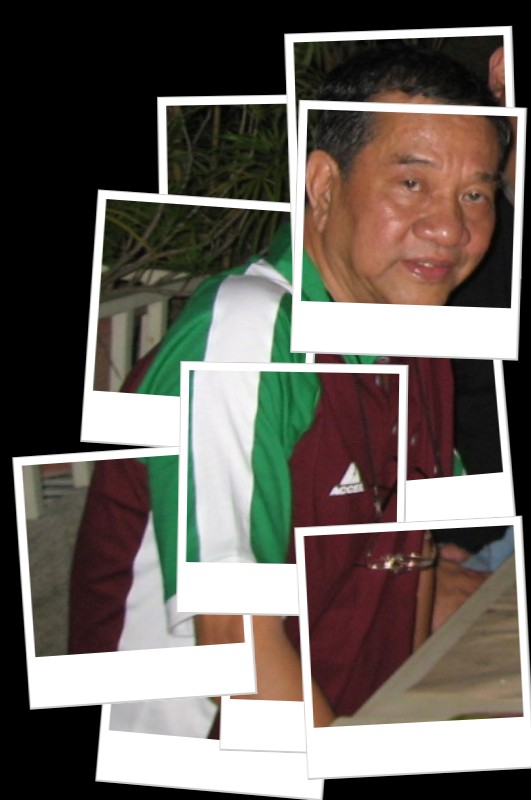
Head Coach Joe Lipa Jr., ever the mentor and tormentor, used more than a few words. To emphasize the import of his words, he would hark back to what he had already said, repeat it, this time accentuating his earnestness by chopping the air with his right hand and peppering his speech with OKs—as if to say, Are you listening to me, boys? OK?
On building character
(Number of times said: THREE)
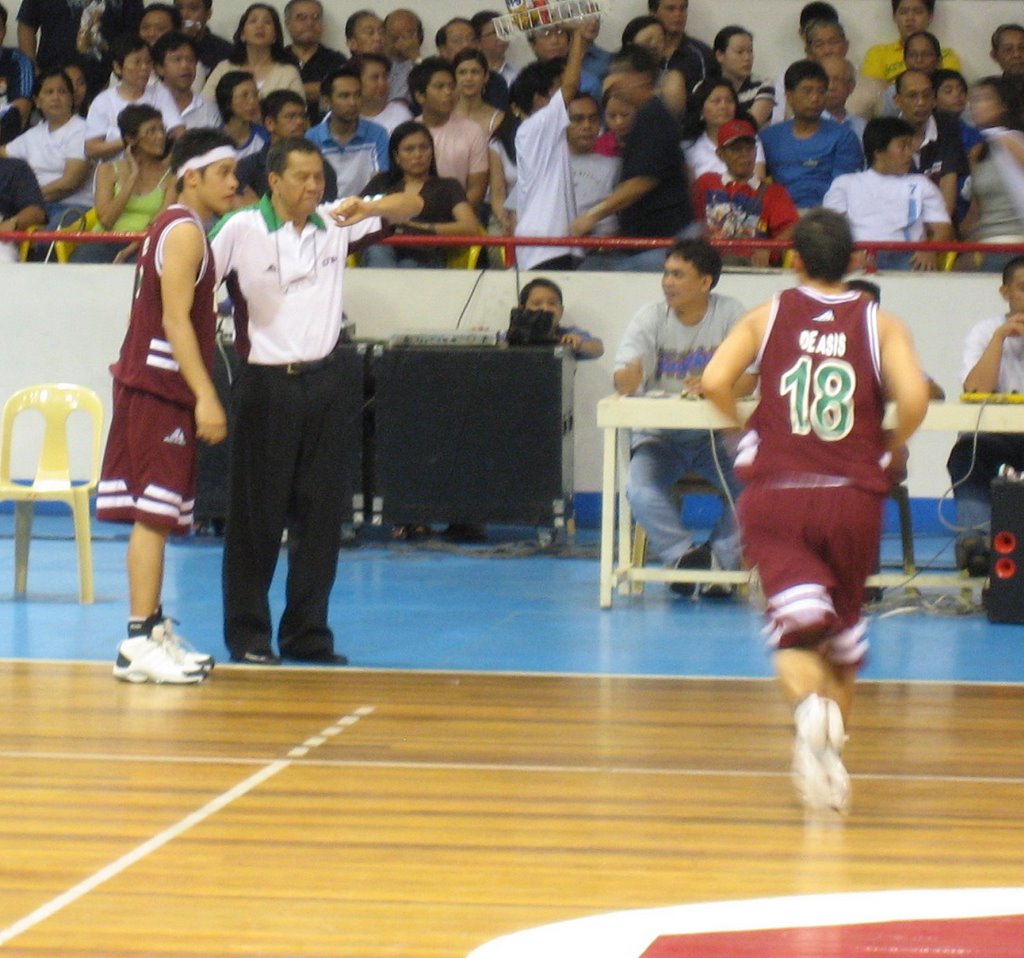 “Boys,” Coach Joe said, in his gravelly, pongalangala voice. “So many people have taught you basketball: from your grade-school coaches to your high-school coaches. What we from the UP coaching staff really want to do is to teach you to be better men. To be good persons. Nothing is more important than that. OK?”
This is the essence of Coach Joe’s father heart, the kind that singles out character, and knows when victory is important or not important.
On hell
(Number of times said: FIVE)
 The Coach, when it was his turn to speak, quoted from Coach Joe: “The road to success is always under construction.” I suspect this is where Coach Joe was coming from when he would, after already starting on another topic, suddenly remind the boys about training hell.
“Boys,” Coach Joe said, gripping the mike. “Starting next week, expect hell. OK?”
Variations of the same theme were minor:
That is Coach Joe’s philosophy: Work hard. Give honest labor.
- “We are going to start training right away. Next week will be hell. OK?”
- “Boys, expect hell! OK?”
- “We are going to work hard, boys. OK? Expect hell next week!”
On making good coaches
(Number of times said: TWO)
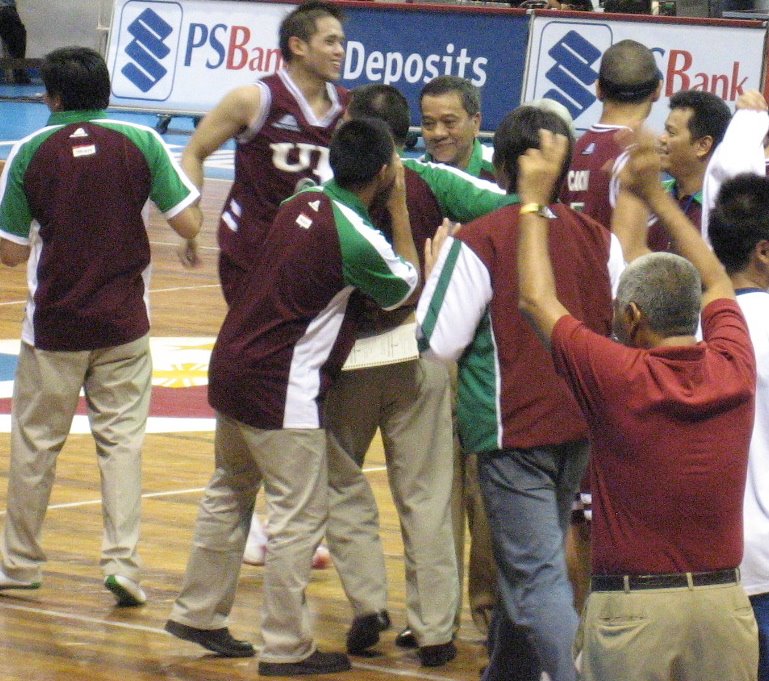 Turning to the other side of the lanai, Coach Joe faced his other “boys” and said, “To my coaching staff, you know that I want you to become good coaches. You also know that I am not fond of reading.* But because I want you to become good coaches and become good men, I have read many books on this, including the books of John Maxwell, so I can help you.”
Coach Joe’s strong personality and stronger convictions arouse either severe alienation or deep affection. He is like tennis star Rafa Nadal: he doesn’t leave his emotions in the locker room. He is like his friend,** Coach Bobby Knight (Indiana University): on and off the court, Coach Joe is intense and will make no bones showing what he feels.

Either you love him or you hate him.
I love him. Very much. I have witnessed through the years how he has parented The Coach as a high-school player who would hang out at the gym to watch the UP MBT practices, as a college varsity player under Coach Joe's tutelage, as a young husband to a skittish wife, and then as a coach who would strike on his own.*** I have seen how, when Coach Joe makes a decision, he thinks of what legacy he can leave the boys: he thinks of consequences, not rewards. When facing any crossroads in his life, he doesn’t have to struggle over what is right and what is wrong: he always chooses what is right. What he does struggle over are the consequences that his right choices bring to his family. But because he is deeply loved, his family—especially dear Tita Ging with her sacrificial heart—walks with him through life’s many unfair twists and turns.
Just as we, whom he counts as friends, also gladly walk with him.
Coach Joe inspires loyalty. I have yet to meet another coach who, without trying, has maintained such love and fidelity from his former players. The Coach, Coach Ramil Cruz, Ateneo Basketball Director Ricky Dandan, Rey Madrid (now an architect, who at one time also got to coach the UP MBT), Coach Bogs Adornado, NU Coach Manny Dandan (whose association with Coach Joe comes through his being Coach Ricky’s brother), and even the coaching staff of Ateneo, Coaches Sandy Arespacochaga, Jamike Jarin and Gene Afable, among many, many others****—all swear by Coach Joe’s friendship, integrity and basketball acuity.
Thank you, Coach Joe. Perhaps it’s true what you said before, that you would not ever get rich, but let me join the many who know that you have made our lives richer.
__________
* The man who claims he doesn’t want to read has written two books on basketball: the iconic Brain and Brawn Basketball and A Basketball Coach’s Guide: Philosophies, Concepts, Strategies and Drills, two books that have helped and challenged many a young coach.
** Coach Joe considers the late Coach Sonny Paguia, longtime NU coach whom The Coach also loves, more his mentor and good friend.
*** I am possibly biased, for Coach Joe often advises The Coach, “Jo, love your wife. Love Janet.” (And though he is not Cebuano, Coach Joe says my name the Cebuano way, accenting the last syllable and adding a lilt to the end. No one else says my name like he does. Each time he meets The Coach, he asks, without fail, “Kumusta na si Janet?” Always. Gentleman that he is, at least to us coaches’ wives, he would apologize for how he or the game has taken our husbands away from us—this said with a slight, courtly bow and a kind pat on the shoulder.)
**** A young coach I met this year, wowed by Coach Joe, told me that he had felt his mind explode when Coach Joe re-introduced him to basketball, at the new things he was learning.
Tuesday, September 05, 2006
UP players don't die...
…they just win big in their last game.
Two hours before UP’s game against powerhouse UE last Sunday, I was fixing The Coach’s UP uniform, the last time for this year. He had just come in from his Air 21 work—yes, on a Sunday, my dear hardworking hubby—to pick up his stuff before running off to coach St Stephen in its game against Jubilee at 2:30 P.M.* UP’s game started at 4 P.M., which meant The Coach would miss a chunk of the UAAP action. It didn’t seem like such a good start.
Yet everything else conspired for UP to win its last game for Season 69.

UP played well, save for a few errant, ano-ba-yan!?! passes that curdle the blood when there were only a few precious minutes left and barely three points in the margin.
But UP led all the way. No deadlocks allowed.
Latecomer Magi Sison was such a delight. He’s just a kid at heart, really, a beanpole in big basketball shoes. And he grins when he dumps a shot or gets a rebound. That is basketball—it’s supposed to be enjoyed, too.
Marvin’s brilliance lasted until the end game, thankfully. Nestor’s on-court spills (the most I’ve seen in his games this season, and I've missed a few) didn’t spoil his showmanship, and the crowd loved him for it. Woody Co—my other favorite among the boys—has been consistently stepping up in defense and offense, working both sides of the floor. Quiet and unassuming, but deadly and intense. I love this kid.
Even the referees helped; they were calling out fouls which they would’ve ignored in the previous games. Gee, the calls were close to favoring UP: not that I would’ve wanted it that way, but, boy, was it a welcome change from being on the other side of the uneven stick. I could’ve sworn the refs did not allow the margin to breach the three-point mark.
Though Binondo heaped a margin of +8 points on UP, it turns out many more bet on UP. Still scratching my head on that one, but I figure it was because it was a no-bearing game for UE.
Whattaheck, I think even UE played in favor of UP. Custodio was a dismal, almost half-hearted shade of himself. Borboran and that other UE kid, whatzisname, didn’t play well either, prompting Coach Dindo Pumaren to put in his second-stringers.
Like we did. In fact all our players were given the chance to rule the court, and I thought, hey, that’s how it should be, at least in our last game and under the circumstances.
Did the fact that it was a non-bearing game for UE play any factor in our win? Well, so what if it did? A win is a win is a win. And if you saw UP’s side of the stadium erupt in a blazon of arms in the air, posters big and small, people standing on their seats, then you’d know how much this victory is sweeter, better, longed for, and earned.
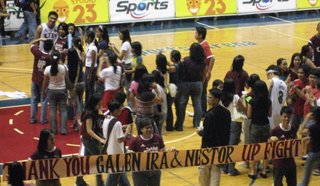
It was a good sendoff for the graduating boys—Galen, Ira and Nestor. I will miss Galen the most, because he was so committed to the game, even in what is probably the shortest stint ever in amateur basketball (barely eight months). Such a loss that we would not see him blossom further, as I know he still can.
At the post-game dinner, the host Jerry Esquivel summed it best when he said that the gathering that night was a beraka, a Hebrew word that means, loosely, a celebration—for any occasion and for any blessing. He said the Jews hold a beraka to celebrate life or a birth, as they would to celebrate death. And so it was only right that the Maroons celebrated both its victories and its defeats.
Until next year, Maroons!
* The Coach won his fourth game against Jubilee. St Stephen now leads the tourney with Chiang Kai Shek at 4-0.
Two hours before UP’s game against powerhouse UE last Sunday, I was fixing The Coach’s UP uniform, the last time for this year. He had just come in from his Air 21 work—yes, on a Sunday, my dear hardworking hubby—to pick up his stuff before running off to coach St Stephen in its game against Jubilee at 2:30 P.M.* UP’s game started at 4 P.M., which meant The Coach would miss a chunk of the UAAP action. It didn’t seem like such a good start.
Yet everything else conspired for UP to win its last game for Season 69.
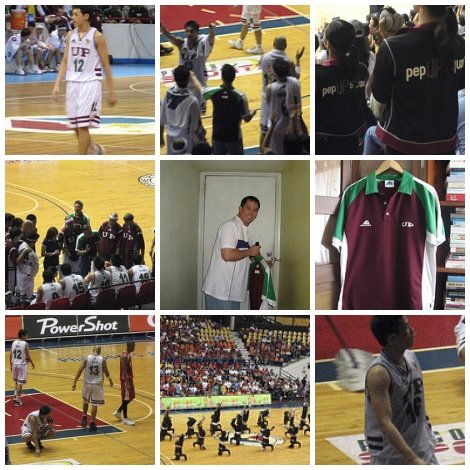
UP played well, save for a few errant, ano-ba-yan!?! passes that curdle the blood when there were only a few precious minutes left and barely three points in the margin.
But UP led all the way. No deadlocks allowed.
Latecomer Magi Sison was such a delight. He’s just a kid at heart, really, a beanpole in big basketball shoes. And he grins when he dumps a shot or gets a rebound. That is basketball—it’s supposed to be enjoyed, too.
Marvin’s brilliance lasted until the end game, thankfully. Nestor’s on-court spills (the most I’ve seen in his games this season, and I've missed a few) didn’t spoil his showmanship, and the crowd loved him for it. Woody Co—my other favorite among the boys—has been consistently stepping up in defense and offense, working both sides of the floor. Quiet and unassuming, but deadly and intense. I love this kid.
Even the referees helped; they were calling out fouls which they would’ve ignored in the previous games. Gee, the calls were close to favoring UP: not that I would’ve wanted it that way, but, boy, was it a welcome change from being on the other side of the uneven stick. I could’ve sworn the refs did not allow the margin to breach the three-point mark.
Though Binondo heaped a margin of +8 points on UP, it turns out many more bet on UP. Still scratching my head on that one, but I figure it was because it was a no-bearing game for UE.
Whattaheck, I think even UE played in favor of UP. Custodio was a dismal, almost half-hearted shade of himself. Borboran and that other UE kid, whatzisname, didn’t play well either, prompting Coach Dindo Pumaren to put in his second-stringers.
Like we did. In fact all our players were given the chance to rule the court, and I thought, hey, that’s how it should be, at least in our last game and under the circumstances.
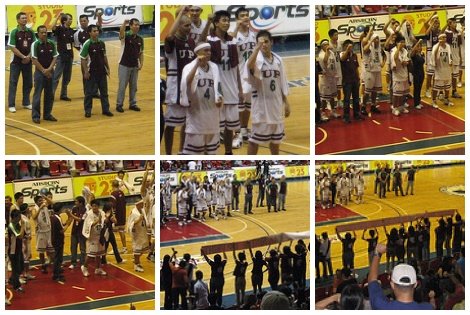
Did the fact that it was a non-bearing game for UE play any factor in our win? Well, so what if it did? A win is a win is a win. And if you saw UP’s side of the stadium erupt in a blazon of arms in the air, posters big and small, people standing on their seats, then you’d know how much this victory is sweeter, better, longed for, and earned.
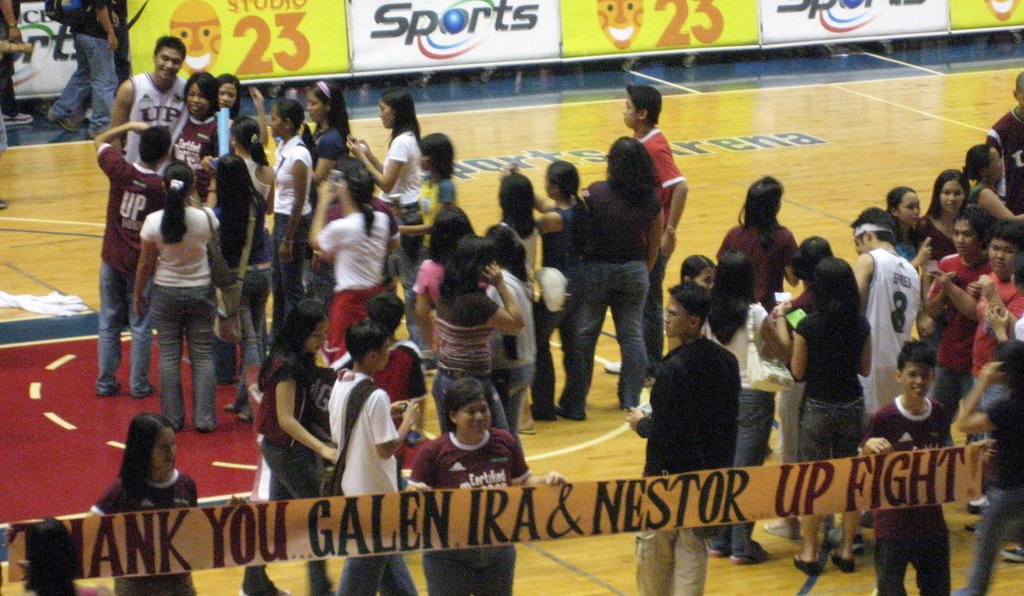
It was a good sendoff for the graduating boys—Galen, Ira and Nestor. I will miss Galen the most, because he was so committed to the game, even in what is probably the shortest stint ever in amateur basketball (barely eight months). Such a loss that we would not see him blossom further, as I know he still can.
At the post-game dinner, the host Jerry Esquivel summed it best when he said that the gathering that night was a beraka, a Hebrew word that means, loosely, a celebration—for any occasion and for any blessing. He said the Jews hold a beraka to celebrate life or a birth, as they would to celebrate death. And so it was only right that the Maroons celebrated both its victories and its defeats.
Until next year, Maroons!
* The Coach won his fourth game against Jubilee. St Stephen now leads the tourney with Chiang Kai Shek at 4-0.
Sunday, September 03, 2006
From our shelf: Questions on life and death
There are books you cannot put down, page-turners that keep you from finishing your work on time.
And then there are books you have to put down, like Thornton Wilder’s The Bridge of San Luis Rey—for you to catch your breath, for you to pump the air with your fist (quietly, of course, lest The Coach wakes from his slumber), for you to reflect on things beyond your ordinary grasp.
 The proposition is provocative: a rope footbridge in Peru, known throughout, breaks in the year 1714, and five people plunge into the chasm below. Brother Juniper who was only a few steps away from crossing the bridge copes with his near-death by grappling with questions—his own brand of catechism: Why these five people? Why spare him? Is it destiny that dictates their deaths? He needs to make sense of the disaster, to find order behind the chaos. He investigates each of the five, chronicling the big and the small of their lives. He mulls: “Either we live by accident and die by accident, or we live by plan and die by plan.” Ironically, the bridge ultimately claims him as its sixth victim: he, with his work, is in the end burned alive for heresy.
Thornton raises questions on “acts of God,” a term I first encountered in law school, sounding to me then severely ominous, like the imprecatory slaying of thousands or the F5 twister. The term, as it is used in contracts, is synonymous to fortuitous events. I remember wondering how lawyers could consider God’s acts—He whom we Christians deem sovereign—as merely happenstance.
Brother Juniper’s commitment to his quest is fueled by his previous, systematic cataloging of fifteen Peruvians who survived and fifteen who died in an earlier pestilence in another town. Brother Juniper rated these thirty people from 1 to 10 on different criteria: each life or soul’s goodness, piety and usefulness. Such calculations were meant to support or counter theological assumptions: do the good really die young? Are the wicked spared from death?
Which, for me, begs another question: is God fair? Did God ordain life to be fair? Our neighbor, truly searching for guidance, accosted me with that question right after the tsunami hit Aceh. We ended up—six of us neighbors—bringing potluck and bibles to our house and discussing the issue further.
God and fair play: what a tricky issue to handle. Something, perhaps, for another day in this blog. Something I’d really like to think about in more depth, too.
I caught the latest film version of The Bridge of San Luis Rey on cable about two months ago but had to let go after some time. I couldn’t continue watching the film. I love Kathy Bates dearly and she is often magnificent in her roles, but in my mind she is not the Marquesa, no. Even Robert de Niro failed to move me. I couldn’t look past their accents and see the book’s Lima, Peru. I’m not sure if that was the film’s fault or mine. Perhaps it would be really difficult to adapt a story wrestling with deep philosophical issues.
And then there are books you have to put down, like Thornton Wilder’s The Bridge of San Luis Rey—for you to catch your breath, for you to pump the air with your fist (quietly, of course, lest The Coach wakes from his slumber), for you to reflect on things beyond your ordinary grasp.
 The proposition is provocative: a rope footbridge in Peru, known throughout, breaks in the year 1714, and five people plunge into the chasm below. Brother Juniper who was only a few steps away from crossing the bridge copes with his near-death by grappling with questions—his own brand of catechism: Why these five people? Why spare him? Is it destiny that dictates their deaths? He needs to make sense of the disaster, to find order behind the chaos. He investigates each of the five, chronicling the big and the small of their lives. He mulls: “Either we live by accident and die by accident, or we live by plan and die by plan.” Ironically, the bridge ultimately claims him as its sixth victim: he, with his work, is in the end burned alive for heresy.
Thornton raises questions on “acts of God,” a term I first encountered in law school, sounding to me then severely ominous, like the imprecatory slaying of thousands or the F5 twister. The term, as it is used in contracts, is synonymous to fortuitous events. I remember wondering how lawyers could consider God’s acts—He whom we Christians deem sovereign—as merely happenstance.
Brother Juniper’s commitment to his quest is fueled by his previous, systematic cataloging of fifteen Peruvians who survived and fifteen who died in an earlier pestilence in another town. Brother Juniper rated these thirty people from 1 to 10 on different criteria: each life or soul’s goodness, piety and usefulness. Such calculations were meant to support or counter theological assumptions: do the good really die young? Are the wicked spared from death?
Which, for me, begs another question: is God fair? Did God ordain life to be fair? Our neighbor, truly searching for guidance, accosted me with that question right after the tsunami hit Aceh. We ended up—six of us neighbors—bringing potluck and bibles to our house and discussing the issue further.
God and fair play: what a tricky issue to handle. Something, perhaps, for another day in this blog. Something I’d really like to think about in more depth, too.
I caught the latest film version of The Bridge of San Luis Rey on cable about two months ago but had to let go after some time. I couldn’t continue watching the film. I love Kathy Bates dearly and she is often magnificent in her roles, but in my mind she is not the Marquesa, no. Even Robert de Niro failed to move me. I couldn’t look past their accents and see the book’s Lima, Peru. I’m not sure if that was the film’s fault or mine. Perhaps it would be really difficult to adapt a story wrestling with deep philosophical issues.
Subscribe to:
Posts (Atom)